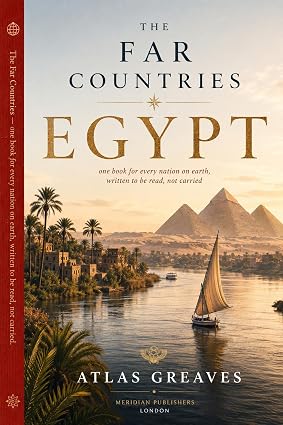
The Far countries: A Traveller's Book of History, Land and Life, things you did not know about Egypt
By Atlas Greaves
You come to Egypt expecting a country. You find a river. From the air, the Nile is a single stroke of green through a wasteland of sand-and along that stroke are the pyramids, the call to prayer, crowded cities, fertile fields, and the longest continuous story any country has to tell. In the fourth book of The Far Countries, correspondent Atlas Greaves follows the Nile from Aswan to the Mediterranean. Along the way are the fellah bent over the black soil his ancestors farmed five thousand years ago; the felucca man who knows the city is new and the river is old; the High Dam that stopped the flood; and the modern fear that another hand, far upstream, may tighten the tap. This is not a guidebook. It will not tell you which tomb to see at dawn or what a felucca should cost. It is a work of literary travel and narrative nonfiction about what a country is rather than how to visit it-its land, history, people, food, faith, cities, and future. For readers drawn to cultural history, evocative travel writing, and ancient places alive in the present, Egypt: The Far Countries offers a vivid portrait of a nation made by water. Follow the river that made Egypt.